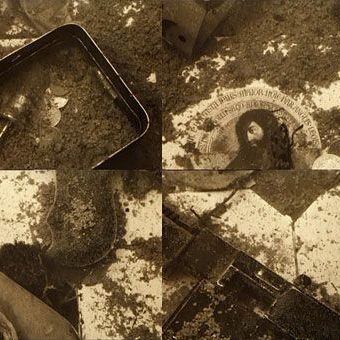
Scattered

“A heap of broken images, where the sun beats,
And the dead tree gives no shelter, the cricket no relief,
And the dry stone no sound of water.”
– T.S. Eliot


I stalk through Battersea Power Station
like a cat in all-too-human space
it is now a shopping mall
a screen onto which consumer craving is projected

An astro turf lawn lines the floor
a lady stands on it selling perfume
The University of Virginia is nicknamed The Lawn;
its lawn hid Thomas Jefferson’s slaves

With Abhayanandi and Ratnaprabha,
we make our way onto charter’d streets
besides the charter’d Thames

The character of Strider resonates
Unlike in Middle Earth,
kings and ideals are distrusted nowadays

Stalker a modern Soviet version of Strider?
prowling through a postindustrial Zone,
seeking grounds for faith

Stalker, the writer, and the professor:
none of them know what they truly want
At the very least their conscious desires are at odds with their unconscious desires
Does anyone know what they truly want or yearn for?
One response to the uncertainty and ambiguity regarding desire is faith
The other? Beckett’s resignation
Alan Watts: “why don’t you know what you want? Two reasons: 1) you’ve already got it. 2) you don’t know yourself.”

My mind is charter’d too of late
The dynamics of transaction
Stasis and distraction
estrangement from myself and others

Return the mind to its original nature

London lacks presence

It is too alive
A metastasizing cancer
Cells reproduce too quickly for no reason
The fractal dimensionality is too high

capitalist growth has a cancerous aliveness too

everyone is pushing too hard
the systems are under strain
You can feel it in the atmosphere
Ominous weight, the wear and tear
Something’s going to snap

Temptation is to return to one’s bunker

Within me is a stalled dialectic 
between the local and the global

I am rootlessly global and brittly cosmopolitan
yet I desire roots and firm ground:
a mountain hide-out
pull the drawbridge up from my surrounding moat

There is too much emphasis on becoming
I need more being

More continuity , less change
The radicals these days are conservatives

(the real ones, not the neoliberal ones)

Things fall apart; the centre cannot hold

What am I seeking? A centre
Ajahn Sucitto: “don’t lose your centre”

Kerianna: stay embodied wherever you go

With a friend : a day’s walk
on the path above Bazalgette’s sewage system
It feels very psychogeography

Admiring of Bazalgette’s accomplishment
Admiring that a sewage system that large can be engineered

in awe of industrial civilization

in awe of the sheer population of people it sustains

Any admiration is tainted by an ominous ecological awareness
Which hangs in the background like an unwelcome guest

I’ve been off the rails since Covid
the ship veered off course in 2019

I’ve got CPTSD (and I’m a walking cliché)

Thanks to those who kept me going
thanks to the sustainers of life

Triratna: a port in the storm

sraddha– sukkha – jaya
but jaya (victory) of the subtle kind, not the Trumpian kind
victory of the subtle kind is what matters

Positive mental states
include those which face difficulty

Health may no longer be possible
but living with illness in dignity is

The Matthew Principle means 
decline builds up exponential momentum
and so does rising up
so take small steps towards rising up

Hold onto goodness
A parachute of hope takes air into its sail
String together days of progress into a vast wave

London swallowed me up and it’s about to spit me out
(again)

Krishnamurti: The Escape from Sorrow

Man suffers, not only personally, but there is immense suffering of man. It is a thing that is pervading the universe. Man has suffered — physically, psychologically, spiritually — for centuries upon centuries. The mother cries because her son is killed. The wife cries because her husband is being brutally mutilated in a war. There is tremendous suffering in the world. I don’t think people are aware, or even feel, this immense sorrow, that is in the world. They are so concerned with their own personal sorrow that they overlook the sorrow of a poor man in a little village in India or in China or in the eastern world, who will never have a full meal, clean clothes, a comfortable bed. And there is this sorrow of thousands of people being killed in war, or in the totalitarian world, millions being executed for ideologies. Tyranny. The terror of all that. So there is all this sorrow in the world. And there is also the personal sorrow. And, without really understanding it, very deeply, and resolving it, passion won’t come out of sorrow. And without passion, how can you see beauty? You can intellectually appreciate a painting, or a poem, or a statue, but you need this great sense of inward bursting of passion, exploding of passion. That creates in itself the sensitivity that can see beauty. So I think it is rather important to understand sorrow. I think it goes in this order — sorrow, passion, beauty.

In the Christian world, if I am not mistaken, sorrow is delegated to a person, and through that person, we somehow escape from sorrow, or we hope to escape from sorrow. In the eastern world, sorrow is rationalized through the statement of karma: what you have done in the past, you pay for in the present. So there are these two categories of escapes. And there are a thousand escapes — whiskey, drugs, sex, going off to attend the Mass. Man has never stayed with a thing. He has always either sought comfort in a belief, in an action, in identification with something greater than himself, but he has never said, look, I must see what this is. I must penetrate it, and not delegate it to someone else. I must go into it, I must face it, I must look at it, I must know what it is. So, when the mind doesn’t escape from this sorrow, either personal or the sorrow of man, if you don’t escape from it or rationalize or try to go beyond or you are not frightened of it, you remain with it. Any movement away from what is is a dissipation of energy. It prevents you understanding what is. What is is sorrow. We have means, and ways, and cunning developments of escapes. But if there is no escape whatsoever, then you remain with it. In everyone’s life, there is an incident which brings you tremendous sorrow. A happening. It might be an incident, a word, an accident, a shattering sense of absolute loneliness. These things happen. And with that comes this sense of utter sorrow. When the mind can remain with that — not move away from it — out of that comes passion. Not the cultivated passion, but the movement of passion, born of non-withdrawal from sorrow.

Jiddu Krishnamurti, San Diego, 1974

Krishnamurti: On Suffering

Suffering is like a jewel, a great jewel. And if you have a great jewel in your hand, you look at it. You marvel at it. You see the beauty of it, how it is set. Platinum, gold, silver. Such delicacy, such refinement, such beauty. A part of you wants to run away from it. In the same way, one can hold that thing sorrow not get morbid and not run away from it. Just hold it and look at it.

Jiddu Krishnamurti, Saanen, 1984

Awakened awareness is

The still, silent point
within the shifting tectonic plates of our lives

A river bank
beside the stream of becoming

A parachute
The pole star
A creased bed sheet pulled smooth

An unhooking
A non-arising

Aware of joy and sorrow, but not joy and sorrow;
aware of samskaras, but not samskaras

The witness
a window onto a window
the prior condition

That which opens, rather than contracts;
that which relates, rather than polarizes

A key in the lock of conditionality

A decentring, not a centring

A hug from Green Tara
full of compassion
a healing nectar

Embodied depths
dropping into a flow of energy
surfing the wave
taste of freedom

Losing things, gaining life
Life is no-thing

Citta viveka

Space, not solidity
Intention, not expectation

Growing through the cracks

Grace, not gravity
angels of our better nature

Narcissus, not Goldmund

Neither a transcendental self
nor a realist world
but a co-arising of self and world

A single unfolding
of nature and mind

Endlessly creative
refracting the daimon

Gelassenheit
a penetration into Being

Signlessness
the unborn
void

Basic sanity

The Holy War

From the river to the sea
Israel can and cannot be

A great sadness grips us
in the distance, a monster
ogre, giant, balrog, Grendel

We travel in scars
we travel in scars
walk of Elysium, but not yet for this wound

Israel, the colonizers, their victory more important than life
Palestinians, we won’t forget you

We are walking through knives

From the river to the sea
Palestine can and cannot be

Us Britons, writing poems in perfect safety, aren’t we clever
get back out on the streets, your highness?

Princess and the pea
may Israel never stop noticing the pea

Tired eyes, we think on appetite
and evil winches up a flag
shields and spears of justifications

Eye for an eye
and now the whole world is blind
we see through cataracts
and sightless we make our simple fuss

Is resolution possible
when justice means taking a side?
Defending a position?

No sitting on the sidelines
letting the river of Israeli aggression pour forth
erect a dam against the torrent

Coaxed by our shame
we take to the streets
force the politicians to take note
with feet and song we make our vote

Palestinians swim
from the river to the sea
let their heads stay above water
from the river to the sea

A city of two Gods
a tale of two cities
around and around
blood by blight
sink or swim
decades of vendettas

Cain kills Abel in an olive grove
the olive grove where Jesus walked
Two men looked out through prison bars
one saw mud, the other stars

Submarine

Trident submarine
cranking in the murk
like an underwater AI

A strange fish
glass mechanical eyeballs

Lights snorkel in the abyss
Is it a whale or a UFO?

Conjured from reason
Oppenheimer’s delight

In the dark, the nuclear reactor

Here we are
in the depths
of everything we refuse to know

Truth so close we don’t see it

Beeps of the radar

The first to detect war
and the last to engage with it

Dark crucible
angry creativity
huding from Russians

The final shrieks of the bomb-taut fellows
fatherless depths
“ma mere! ma mere!”

An imposter
full fathom five

In Aqueous caverns
of formless silence

A new life form on Earth
alien, undetectable

Bi-directional dynamics
with the sea

Uncanny dialogue

Godot

In the beginning was the word
and the word was Godot

In the beginning was the grid
and the grid was nihilism

And Godot smiled upon the earth

Godot found himself drawing grids
to escape domestic oblivion

Godot believes in sound art and lemon cake

Godot dismisses all creeds
including light and divinity

He decides not to wear grey as it is a cliche
instead he wears off-yellow

He likes wall climbing in his spare time

Godot loves the word ‘melancholy’
it reminds him of his hero Heathcliff

He is definitely not sympathetic
except with slugs
who sometimes make him cry

He is often found
washed up on the beach
with an empty milk carton

He is slightly puzzled that he doesn’t exist

The Urban Gardener

Seedlings in promise
angels trying to go north

Diamonds in rubble

I tried through concrete
to respect the damage done

I want to see humans and cities
as more than just a disease

A single bullet tube train

Thousands of experiences
unfolding around me

A single techno beat
pulsating towards the dopamine hit

Hungry ghosts
grasping after “me” and “mine”

At the community garden,
I’m welcomed by a blaze
of sunflowers and nasturtiums

Time slows down
Chronos becomes kairos

Presence and wonder
in an urban haze of information

I’m practicing indigeneity
to a green pocket,
an apple tree at its centre

My meditation pose
is ouroboric recursion

Beside the apple tree
a serpent coils in on itself

Beetroot blushes its purple haze
fractal florets of a Romanesco cauliflower

A slow explosion of purple and yellow

Rotting artichokes and lettuces
sink in a compost of decay

Mould of compost,
neither alive nor dead

but a queer in-between state
the juicy “real” of decomposition

The fresh petrichor smell
of foxgloves after rain

plays aikido with my life force
laying it out flat to rest in space

Sounds of the city cease
motor engines fade

The presence of silence

For Rose

By the beach edge,
tide laps in, tide laps out
Sun sets, moon rises

Trees and marram grass sway,
smooth like liquid
The night breeze caresses them,
opening dimensions between senses
Shimmer-hum of the sea-wind

Haunted trees, frightened leaves
Moonlight filters through branches,
a strobe lighting
dancing in our retinas
Friend or foe?

A tension between us

Background becomes foreground,
eerily swinging into focus

Our minds are fragile webs
in open space
We have been caught in push/pull,
imagining ourselves to be separate, solid beings,
cages without birds

On a porch by an abandoned beach house
we sit in a swinging chair,
its creak loud to sensitive ears

Mrs Ramsay prepares dinner inside
while Mr Ramsay strides before us with furrowed brow
Lily Briscoe paints the scene

I thought I was Mr Ramsay
and Rose was Mrs Ramsay
but maybe I’m Lily

A lighthouse glows on the horizon

Echinacea and chamomile
in the crumbling back garden
are effulgent with fragrance,
even as stony walls decay

I turn to Rose
“Thank you for everything
immersed in abundance,
I only noticed scarcity”

Distant clouds crack open
luminescent lightning
ecstatic electricity

Rose runs off across the pebbles
in terror and delight,
laughing like Milarepa,
at one with the elements

The beach turns into a hieroglyph;
her figure is a question mark

Thoughts dissolve in reverberations of thunder

A crow soars through the air,
in the air channel between life and death
it looks down with indifference

We are two nodes in Indra’s net,
two non-local particles a quantum leap apart

Further down the beach
a Yoruba tribe dances around a fire
multi-coloured tunics
beating of drums
fireflies flutter