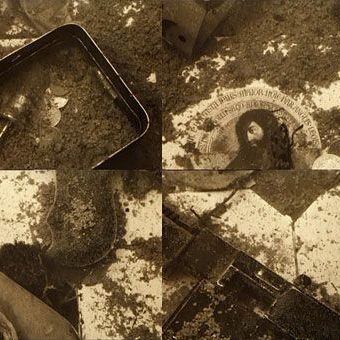
What was worse
than the treefer
twanging dizziness
numbing my brain
was the emptiness
that underlay it all.
Vitality vacuumed out.
No-one mattered.
I was a nexus of neurons
in a deaf universe.
Essay: Divining The Way
I am writing to clarify an evolution in my outlook that has taken place latterly. In recent years, I have lived in eco-communities and “alternative” towns in the South West, in large part because I was attracted to what I loosely call “Western Buddhism”. Fifteen months ago, for different and obvious reasons, I moved to Oxford to train as a teacher. I set out in what follows to capture – if possible, to reconcile – these contradictory impulses.
ROUTE ONE: “DON’T JUST DO SOMETHING, SIT THERE”
In my mid-twenties, I went through a personal crisis which resulted in a downward spiral. My idea of myself splintered, as did my faith in the social value systems which were a factor in the construction of that self-image. I realise now that this was an overreaction but I was too overwhelmed by events to see clearly. The fissure has since allowed me to observe my psychological processes and the society I am part of more clearly.
I began volunteering at an eco-community called Embercombe, in the hope that working outdoors in a communal setting would restore my sense of wellbeing. Indeed it did. An important revelation there was an awareness of my interconnection with nature. Being on the land every day, I began to feel that just as plants come from nature, so I come from nature, and some essence underlay it all. The divide between myself and the world faded.
Volunteers were encouraged to check in with each other every morning. In a space of non-judgement and compassion where people would listen without comment, we would articulate our vulnerabilities – a powerfully transformative process to witness and be part of. These check-ins enabled me to accept a reality I had spent months denying. As the Buddha said, “be where you are, otherwise your life will slip away.” The only way to let go of a painful reality is to delve into it and express it.
My experience at Embercombe influenced my decision to move to a town with similar ideals called Frome. Here I collaborated with others in the development of a social enterprise, which was a productive period for me. In my spare time, I drank with friends around campfires, went to free dance evenings (called 5 Rhythms), meditated in the countryside, experimented with psychedelia and melted in sweat lodges. These hedonistic activities were all geared towards loosening the grip of the mind.
Mindful meditation is a powerful process and I cannot deny the potential for a complete shift in consciousness when done correctly. It has its roots in Theravada Buddhism. In directing your attention towards your environment, your bodily sensation and your breath, you become less hypnotised by the unceasing narrative of judgements in your mind. Individual thoughts dissolve into an uninterrupted flow of consciousness. A second realisation then occurs: that there is no ego, no “I”, no thinker distinguishable from thoughts, no experiencer distinguishable from experiences, no passenger riding around in the vehicle of your mind. All that is left is pure awareness.
While there are elements of truth in this process, my mistake was to take it for the whole truth. Problems for me began after work on the social enterprise finished. My attempts at mindfulness did not result in liberation from samsara. I wrote short stories and meditated in my room. One phrase by Alan Watts reverberated with me at this time: “the meaning of life is just to be alive. It is so plain and so obvious and so simple. And yet, everybody rushes around in a great panic as if it were necessary to achieve something beyond themselves.”
I came to feel that Watts misinterprets life’s meaning here – or, rather, he partially interprets it. It is not that “everybody rushes around… as if it were necessary to achieve something beyond themselves.” Everybody rushes around because it is necessary to achieve something beyond ourselves. To focus only on the present moment felt like a betrayal of my future self. I had a fundamental need to do as well as to be. Yet Alan Watts smooths over this innate drive into a flat being.
My tendency for over-thinking increased rather than decreased. Concerns like getting a better paid job in order to pay rent demanded my focus. It appeared foolish to be seeking self-transcendence while others were doing the actual selfless act of working every day. By gaining material stability, would I not be embodying an immaterial set of values?
ROUTE TWO: “DON’T JUST SIT THERE, DO SOMETHING”
After a year-and-a-half of embracing “Western Buddhism”, I switched to being proactive in my actions and more realistic with my job goals. Despite previously struggling with teaching, I decided to redo a teacher training course in Oxford. So I ditched my Tibetan singing bowl and dusted my old pedagogy books off. Time for a dose of hard-nosed pragmatism.
Adjusting to the demands of the course was difficult. Within weeks I was juggling classroom practice, lesson planning, marking books and reading educational theory. Even for the most organised person, it would have been a step up. There were also stricter professional expectations. Gradually, I grew into the routine that school life gave me, and I discovered that the rigidity of the structure and expectations were the opposite of a constriction to me.
My experiences of teaching taught me about human nature. The key notion underlying my classes was that of progress. Most students worked tirelessly to impress me and receive a credit. I suspect that students who misbehaved did so because of low confidence. If I praised these students for what they had accomplished or gave them targets regarding the progress they could make, they would refocus.
Applying the same rationale of progress to my own life was beneficial. It is not a hypothesis that human beings need a purpose; the circuitry underlying positive emotion is well understood. Positive emotion is a consequence of seeing that one’s actions are working well as one proceeds towards a goal.
Far from the the attempt to “let go” I had previously employed, I drove towards my aims. I played the game of the ego: weighing up my victories against my losses, taking on the world as an individual agent. No-one was going to come to my rescue and no cosmic net would catch me if I fell. Responsibility for myself now lay with myself.
Not being the most natural teacher, there were a few touch-and-go moments on the course, yet I did not need to worry. Within the kernel of the initial decision to start the course lay the motion that would carry me to my aim. Freedom is not, as Alan Watts or D.T. Suzuki might put it, “freedom from the content of consciousness”. Freedom is walking on the path you have chosen.
ROUTE THREE: “DON’T JUST SIT THERE, DO SOMETHING – AND THEN SIT THERE”
My relief at passing the course confirms to me that external recognition, linked to an accomplished aim, is a rewarding experience. At the same time, I recognise that my teacher training was not a smooth ride by any means, and I know that using egoistic notions as a yard stick to measure my self-worth is unwise. These discrepancies prompt me to question if I have been too quick in dismissing a more expansive outlook on life.
The issue for me, really, is how to reconcile my “Western Buddhist” inclinations with an ethic of external encounter, an ethic of the Fall. One possibility is by seeing mindfulness not as inner detachment but as a way of falling further. Nirvana is not some ethereal, heavenly state but here in the day-to-day. The sphere of non-self is always already in motion, and the Buddhist practitioner attempts to shift that motion into a movement towards liberation.
Simone Weil, a Christian mystic, explores the tension between between will and attention, a tension I have also been trying to resolve. Her writings bear a resemblance to Buddhist thought: “We have to try to cure our faults by attention and not by will. The will only controls a few movements of a few muscles, and these movements are associated with the idea of the change of position of nearby objects. I can will to put my hand flat on the table. If inner purity, inspiration or truth of thought were necessarily associated with attitudes of this kind, they might be the object of will. As this is not the case, inner supplication is the only reasonable way; for it avoids stiffening muscles which have nothing to do with the matter. What could be more stupid than to tighten up our muscles and set our jaws about virtue, or poetry, or the solution of a problem. Attention is something quite different.”
Weil’s example of attention in poetry-writing fits with my own experience of the creative process: firstly I tune into my environment, and words follow, like a receipt that pops out of the till after a cash transaction. Who am “I” in this process? And is agency retained in a scenario which gives greater emphasis to my surroundings than me?
Insights from psychoanalysis aid me with these questions. Buddhism and psychoanalysis are, in crucial respects, philosophical kindred spirits. Both posit an emptiness or gap at the centre of us humans, which we are always striving to fill with whatever’s possible: objects and possessions, self/identity projects, community/nation projects. And both posit that only by facing this gap directly can genuine love become possible.
For Buddhism, the way to traverse the gap is by gaining insight into the illusory nature of our inner separation: the Buddhist practitioner changes not the object but herself. In so doing, the practitioner is released from the wheel of suffering. But in psychoanalysis, one can recognise the gap while retaining an unconditional fidelity to one’s desire, and the wheel continues to turn. Even when the subject has “traversed the fantasy”, the Freudian “drive” continues.
By elevating the Freudian “drive”, psychoanalysis draws a clear distinction between human consciousness and reality. Reality is mute matter, mere existence, which human consciousness transcends. What is valued is subjectivity at the point of its (individual) creation. On the other hand, the movement of the Buddhist practitioner towards liberation (nirvana) means that Buddhism views reality — not just human but all reality — as the ongoing production of what might be called subjectless subjectivity. The will is not extinguished here, just less primary.
My capacities and energies that I describe in “Route Two” can be integrated into the Buddhist framework. It is a common misconception to see Buddhism as a nihilistic philosophy. Emptiness (Śūnyatā) is not annihilationism; in my mind, the word “emptiness” needs more words accompanying it such as “…of fixed/separate/independent/enduring existence or selfhood”. Some unconventional translations that I quite like are “the open dimension of being”, “non-fixed-ness”, and “un-pin-down-ability”. I choose to continue on the Buddhist path, a path where the boundaries of self and world are softened without being eradicated, where non-clinging does not mean inertia, a path where I can dance to the music of life without resistance.
Reflections on WWOOFing
I cannot recommend the experience of WWOOFing highly enough. WWOOF stands for world wide opportunities on organic farms. In the two months leading up to Christmas I WWOOFed at three different farms/communities in the south west: Trill Farm, Keveral Farm and Tinker’s Bubble. I had quite a profound time which I’d like to share in the faint hope that it might be of interest to those with a similar outlook on life.
Tinker’s Bubble was the barest and most minimal of the communities I volunteered at. While the community’s principled stance towards the sustainability and low-impact living garnered my respect straight away, it was the vitality of the lifestyle which really affected me. I slept in an austere cabin with nothing but a wood burning stove to keep me warm. Using my body, working outside all day, eating a hearty evening meal, sitting quietly by the fire and living as part of a community enabled me to see what is truly important in life: exercise, food, drink, sleep, breath and human fellowship. We take these things for granted even though they are great gifts and by finally appreciating them I achieved a natural high.
There was a quiet there which I realised I had longed for since I was young. Modern society is very uncomfortable with the notion of peace and quiet. In cafes and shops inane music plays, on trains people distract themselves with phones and seeking out the next distraction is the order of the day. I have partially been conditioned to live this way too and in fact on the first day my initial sense was that of dread. But as I confronted the fact that I was alone with myself, that solitude became like oxygen to me. Being in the calm, soulful silence of that rustic cabin was reality, not society’s extravagant distractions outside.
Keveral Farm, the second farm I volunteered at, is situated on the Cornish coast. From 8.00 to 4.00 every day I would pick vegetables with three other wwoofers on the vast acres of land Keveral owns. The fields were spread out all about us, on a slight rise, so that as we worked we could see out across the sea. The waves danced and rolled, a never-ending sequence of movement, and as the clouds parted the sun shone along a narrow strip of ocean. There is something glorious about movement. It reminds you that nothing is constant. Everything is happening. With every new second the waves change shape and size and colour in a marvellous interweaving of the two key forces of life: space and time. Sometimes I listened to music as I worked and the movement of the notes and pitches echoed the movement of the waves.
I became aware of a powerful feeling of peace and harmony deep within my core. I felt like I was rising outside of myself. I was floating, regressing, all the while possessed by an immense wonder. The more I think about it, the more I realise that everyone is trying to access this state in some way or another: through imagination, music, Art, meditation, religion, love, work, alcohol, writing, even sport. I believe Daniel Day-Lewis is the greatest actor of his generation because of the level of self-obliteration he attains in his acting. As Thomas Middleton once wrote “I think man’s happiest when he forgets himself.”
Since returning from WWOOFing I have looked into Buddhism, mindfulness and the ideas of Alan Watts as a way of making sense of these experiences. Alan Watts says that what you are doing at any moment is part of what the whole universe is doing. just as what a wave is doing at any moment is part of what the whole ocean is doing. The more I worked in nature the more I realised that I am fundamentally connected to the universe. There are two ‘I’s. There is the ‘I’ of my ego, which separates itself from others and anything ‘out there’, and a deeper awareness which knows no separation, from the world, from my thoughts, from internal and external events. Once I quietened down my mind and focused on the latter, I became incredibly free…
So, if you ever have a few free weeks and want to get out of the city, I would say: go WWOOFing! I had two of the most rewarding months of my life. It allows for a kind of rest and rehabilitation of the soul.
The Middle Way
Some people, in crisis or on cloud nine,
find in the commonplace a holy glow.
Beauty presides where all was in decline.
The gods whisper secrets from long ago.
Others, with furrowed brows and little mirth,
hustle and strive on everyday terrain,
deny the spirit for the fruits of earth
on the battlefield of loss and great gain.
I, seeking balance, choose the middle way,
navigate my ship through turbulent seas,
aim beyond squalls for a white sandy bay,
knowing each freak wave could rip into me.
Once my craft is built with firm foundations,
I listen to the wind’s incantations.
Web
Morning dew on the web gleams
like dreams of the future.
As the day wears on, droplets melt
in the instant’s heat.
Strands of past stick with an oiliness
and stifle identities in its silky snare,
while cords of present pin all down
in a latticework.
It is a wondrous web, still.
New angles, new patterns.
Its existence is mysterious;
the weaver blessed.
Returning from the Highlands
Days in the Highlands which defy man’s laws,
where stark landscapes are steeped in power
and nature’s megalithic mountains steam roll
with brutal beauty the edifices of my mind
From hostile hills I travel to the hostile city
of glass skyscrapers and glass souls
Whirring alpine winds become whirring car engines
and whirring ambitions revving in my heart
My internal clock, ticking ominously, reads
27 years, 8 months, 17 days old GMT,
so I race around in order to put the brakes on
and accelerate with the aim of slowing down
This man-made wilderness of brick and mortar
– an archipelago of urban morasses –
is one large stopwatch, each person an axle
or corroded cog or rusty mechanism within
So farewell to a wild free Scottish realm
where jagged peaks jut before me like a choppy sea
rippling outwards with unfathomable depth,
waves of infinitude lathering the temporal
Beirut
Zach, your balkan folk hymns
conjure new worlds
and celebrate ancient cultures
with the virtuosity
of a musical shaman.
Your soundscapes, woven together by
quavering flugelhorns and dancing ukuleles,
invoke Slavic villages
and forlorn, empty streets,
where the the sun is setting.
Your soaring trumpet tunes
tap into hidden, enchanting codes
and quicken my blood flow.
Your harmonies ferment into potent wine
whose vintage effects
imbue me with nostalgia
for the countries of my imagination.
Zach, my greatest teacher, friend and solace,
whatever you sing is better than to know
for melodies are more than words.
Meditation
A glistening pool,
hidden in plain sight,
cuts like ice
or blissful fire
through constructed worlds –
freeing awareness
of thoughts in space,
ripples in a larger flow,
tides lapping on one shore –
where past and future
converge in presence
and time is a mirage,
a dance of light
on undulating water.
A living openness
permeates all,
dissolving tangles
into shimmers.
 Chris Stewart